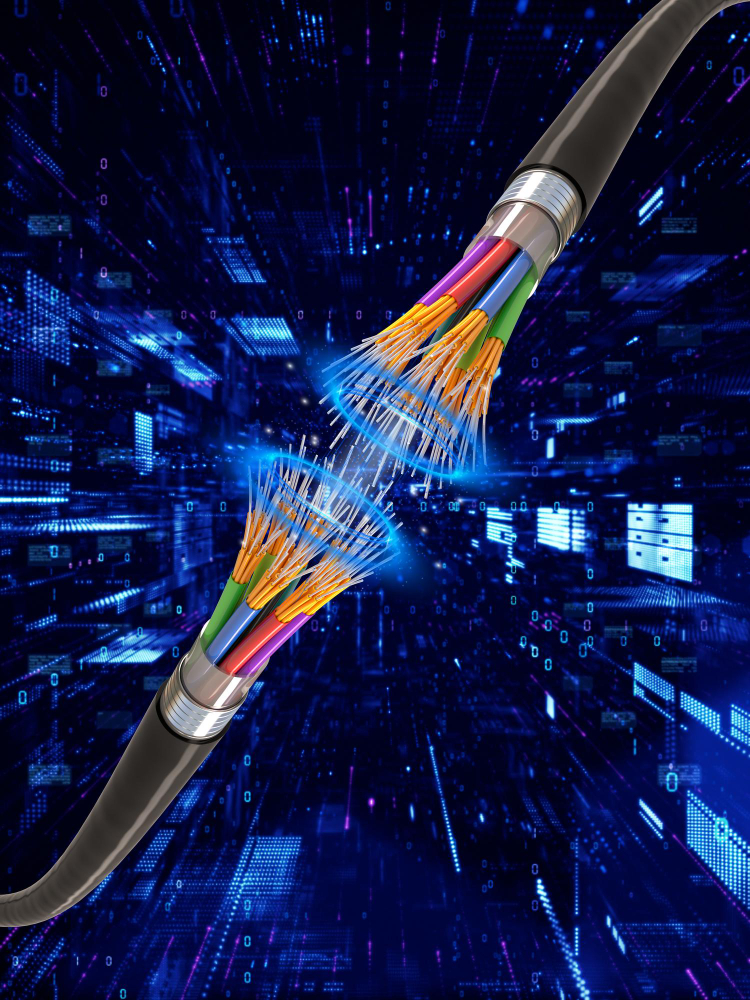
As global data volumes reach unprecedented levels in 2026, organizations across every sector—from telecommunications to industrial automation—rely on high-speed communication infrastructure to maintain operational efficiency. The backbone of this infrastructure is the Fiber Optical transceiver.
This critical component acts as the bridge between electrical and optical worlds, converting electrical data pulses from a switch or router into light signals (photons) and back again. By facilitating this photoelectric conversion, a Fiber Optical transceiver enables data to travel at near-light speeds across fiber optic lines with significantly lower attenuation than traditional copper.
1. Improving Bandwidth and Reducing Latency
One of the most significant advantages of using a Fiber Optical transceiver is its ability to bypass the physical limitations of copper cabling. While copper suffers from the “skin effect” and heat generation at high frequencies, optical fiber provides an almost limitless frequency spectrum.
In 2026, standard network architectures have moved beyond 10G and 100G, with a focus on 400G and 800G throughput. A high-quality Fiber Optical transceiver minimizes latency by utilizing advanced modulation techniques like PAM4 (Pulse Amplitude Modulation), ensuring that real-time analytics, high-frequency trading, and cloud computing clusters operate without delays.
Prestonics assists customers in selecting the right laser type for these modules—whether it’s a VCSEL (Vertical-Cavity Surface-Emitting Laser) for short-reach multi-mode fiber or a DFB (Distributed Feedback) laser for long-haul single-mode applications.
2. Enhancing Signal Integrity and Long-Distance Transmission
Copper-based links are inherently vulnerable to Electromagnetic Interference (EMI) and Radio Frequency Interference (RFI). In an industrial environment or an aircraft, this noise can corrupt data packets, leading to high error rates and retransmissions.
A Fiber Optical transceiver eliminates these vulnerabilities entirely. Since data is transmitted as light through glass or plastic fibers, it is immune to electromagnetic noise. Furthermore, the signal attenuation in fiber is remarkably low:
-
Copper (Cat6a): Significant loss beyond $100 \text{ meters}$.
-
Multi-Mode Fiber (MMF): Reliable up to $500 \text{ meters}$.
-
Single-Mode Fiber (SMF): Can maintain signal integrity over $10 \text{ to } 80 \text{ kilometers}$ without amplification.
By incorporating a high-performance Fiber Optical transceiver, engineers achieve a cleaner signal path and a lower Bit Error Rate (BER), which directly improves overall system reliability in mission-critical defense and telecommunication grids.
3. Scalable Form Factors: From SFP to QSFP-DD
Modern networks require the flexibility to scale without tearing out existing hardware. The versatility of the Fiber Optical transceiver is evident in its various standardized form factors:
| Form Factor | Typical Speed | Common Application |
| SFP+ | $10 \text{ Gbps}$ | Enterprise LAN / Business networks |
| SFP28 | $25 \text{ Gbps}$ | 5G Fronthaul / Data Centers |
| QSFP28 | $100 \text{ Gbps}$ | High-performance switch-to-switch links |
| QSFP-DD | $400G / 800G$ | AI clusters and Hyperscale data centers |
This modularity allows system designers to upgrade their network capacity simply by swapping the Fiber Optical transceiver module, ensuring that the hardware remains relevant as data demands increase.
4. Advanced Multiplexing Techniques (WDM)
To further maximize network efficiency, modern transceivers often utilize Wavelength Division Multiplexing (WDM). This technique allows a single Fiber Optical transceiver to send and receive multiple data channels over a single strand of fiber by using different “colors” (wavelengths) of light.
Whether using CWDM (Coarse) or DWDM (Dense) technology, WDM effectively multiplies the bandwidth of existing fiber infrastructure by a factor of 8, 16, or even 80. With the expert guidance of Prestonics, companies can implement these sophisticated optical solutions to support long-term growth and maintain a competitive edge in a data-driven world.
Future-Proof Your Network Architecture
In the competitive landscape of 2026, the quality of your optical components is the difference between a resilient network and a vulnerable one. Integrating a high-grade Fiber Optical transceiver is the most effective way to ensure your infrastructure can handle the demands of tomorrow.
Prestonics is committed to providing the technical expertise and the high-reliability components needed for demanding installations. Interested in optimizing your throughput? Contact us today.