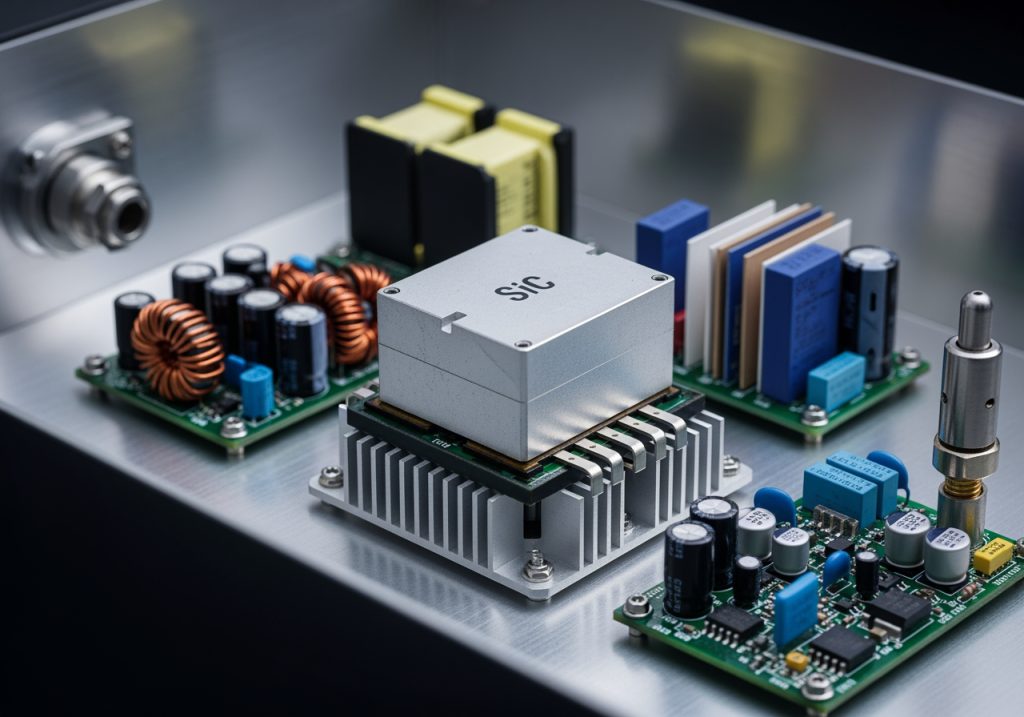
High-voltage systems in 2026 demand components that handle extreme electrical stress while maintaining peak efficiency and thermal control. While traditional Silicon (Si) power devices have served the industry for decades, they are reaching their physical limits. Modern applications—renewable energy converters, EV platforms (800V+), and defense electronics—now require the performance levels of a SiC Device.
Built on Silicon Carbide, this WBG technology offers substantial improvements in breakdown field strength and thermal conductivity. By utilizing a SiC Device, engineering teams can transcend Silicon’s limitations, operating at higher voltages, temperatures, and switching frequencies than ever before.
1. Efficiency Gains: Slashing Conduction and Switching Losses
The primary advantage of a SiC Device lies in its ability to minimize total system losses. Unlike Silicon, which has a bandgap of approximately $1.1 \text{ eV}$, Silicon Carbide boasts a wide bandgap of $\approx 3.2 \text{ eV}$. This property leads to:
-
Lower $R_{DS(on)}$: Reduced resistance in the “on” state minimizes conduction losses.
-
Zero Reverse Recovery: SiC Schottky diodes and MOSFETs virtually eliminate switching losses, allowing converters to run cooler.
-
Higher Power Density: By operating at higher frequencies, a SiC Device allows for significantly smaller magnetic components (inductors and transformers), reducing the overall system footprint.
2. Superior Thermal Performance in Extreme Environments
Heat management remains a primary hurdle in high-voltage design. A SiC Device can reliably operate at junction temperatures ($T_j$) exceeding $200°C$, far beyond the $150°C$ limit of traditional Silicon.
Thermal Conductivity Comparison
| Material | Bandgap (eV) | Thermal Conductivity (W/m⋅K) | Max Op Temp |
| Silicon (Si) | $1.1$ | $\approx 150$ | $150°C$ |
| Silicon Carbide (SiC) | $3.2$ | $\approx 370 – 490$ | $250°C+$ |
| Gallium Nitride (GaN) | $3.4$ | $\approx 130$ | $200°C$ |
This inherent thermal stability ensures that a SiC Device maintains consistent electrical behavior despite temperature fluctuations, which is vital for sealed military platforms and telecom infrastructure.
3. Faster Switching Speeds and Increased Power Density
Beyond efficiency, Silicon Carbide technology enables ultra-fast switching speeds. This allows for more precise control in motor drives and high-voltage DC (HVDC) systems. Increased switching frequency directly correlates with higher power density—delivering more kilowatts per kilogram of system weight.
When properly managed, the fast transient response of a SiC Device improves overall system stability. Prestonics assists engineering teams in navigating the complexities of high $dV/dt$ environments, providing component options that integrate smoothly into advanced power architectures without requiring radical redesigns.
Optimize Your High-Voltage Design Today
In the competitive landscape of 2026, settling for Silicon is no longer an option for high-performance power stages. Integrating a SiC Device is the most effective way to reduce cooling costs and increase system longevity